early in the story
Waking in the woods
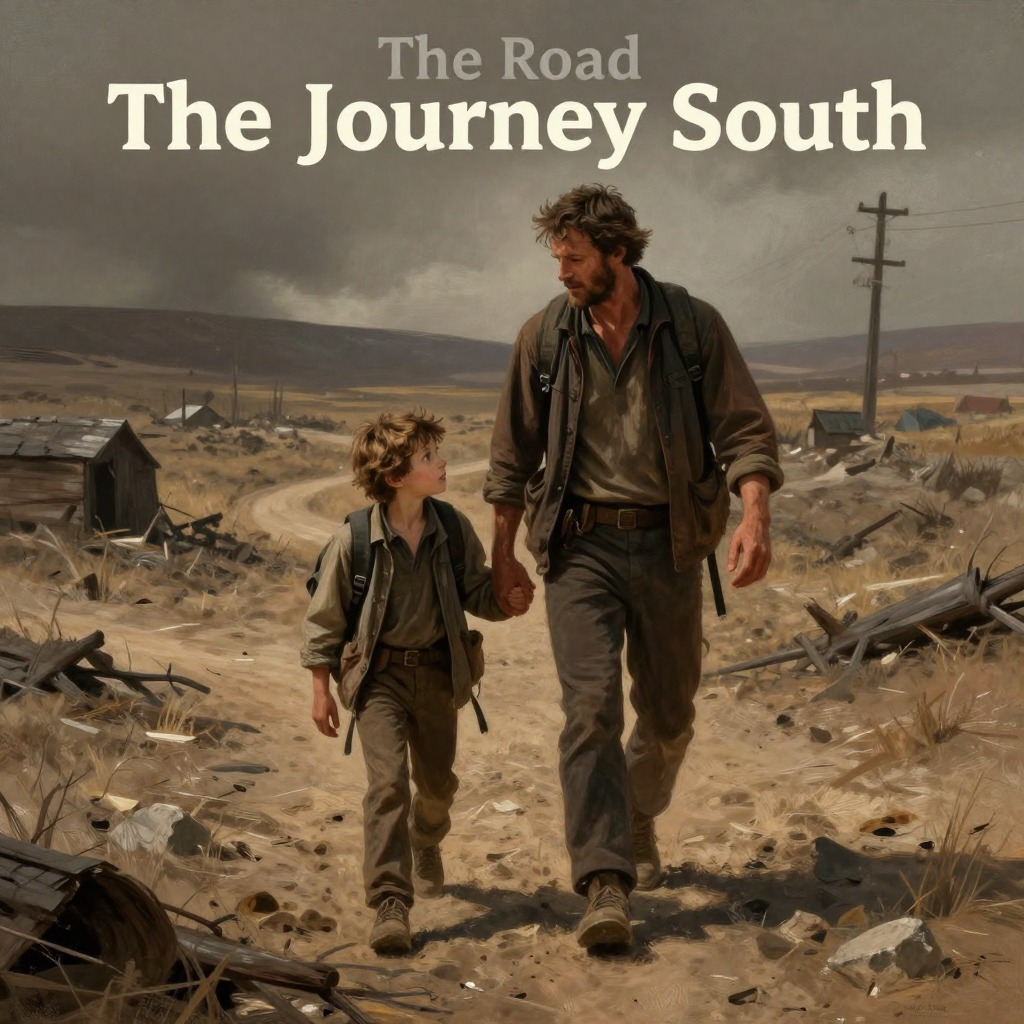
The man wakes in the cold and dark of the woods, reaching out to touch the child sleeping beside him. He reflects on the dream of a cave where the child led him by the hand, and they encountered a pale, sightless creature by a lake. He rises before dawn, studies the barren country to the south, and decides they must move south to survive another winter. He returns to the boy, who wakes, and they prepare to set out on the road.
early in the story
Setting out on the road
The man and the boy pack their belongings into a grocery cart and set out along the blacktop road, each carrying knapsacks with essential items. The man uses a motorcycle mirror to watch the road behind them. They cross a river by an old concrete bridge and come upon a roadside gas station, where they search for supplies but find little. The man dials his father's number on a phone, a nostalgic act, and the boy watches.
early in the story
Collecting motor oil
A quarter mile down the road, the man realizes they should go back to the gas station. They return and find a steel trash drum filled with plastic oil bottles. They decant the dregs of oil into a pan, collecting almost half a quart. The oil will be used for their lamp to light the long gray dusks and dawns. The boy asks if his father can read him a story, and the man agrees.
early in the story
Passing through the burned land
They travel through a stark black burn, with charred trees and ash moving over the road. They see a burned house and a meadowland, and in the distance, the shape of a city like a charcoal drawing. The man uses binoculars to glass the plain, but sees nothing. It begins to rain, and they take shelter under a rock overhang, watching the gray sheets of rain blow across the valley.
early in the story
Camping under the rocks
After the rain clears, they make camp in the dry dirt under the rocks. The man lights a small lamp and they watch the dark come. They eat a cold meal and the boy asks if they can leave the lamp on until he falls asleep. The man agrees. The boy asks if they are going to die, and the man reassures him that they will not die now and they are still going south.
early in the story
The boy's questions about death
In the darkness, the boy asks what the man would do if he died. The man says he would want to die too, so he could be with him. The boy asks if that means they would be together, and the man confirms. The boy says okay and goes to sleep. The man lies listening to the water drip, reflecting on the cold and silence, and wishes his heart were stone.
early in the story
The man's prayer
Before dawn, the man wakes and walks out into the woods. He descends into a gryke in the stone and coughs for a long time. He kneels in the ashes and whispers to God, asking if he will see him at the last, and whether God has a soul. He curses God, then whispers 'Oh God' in despair.
early in the story
Passing through the city
They pass through a city at noon, mostly burned and covered with ash. The man keeps the pistol to hand and the boy close. They see a corpse in a doorway, dried to leather. The man tells the boy that things you put into your head are there forever, and the boy reflects on forgetting. They continue through the desolate streets.
early in the story
Memory of the lake
The man recalls a memory from his childhood: going to a lake with his uncle to gather firewood. They rowed across the lake, dragged a stump behind the boat, and returned in the evening. The man remembers this as the perfect day of his childhood, a day to shape the days upon.
early in the story
Bearing south
They continue south in the days and weeks that follow, through a raw hill country. They see stretches of interstate highway below them. They come to a high gap in the mountains and look out over a great gulf where the country is burned away. They ford the cauterized terrain for days, the boy having painted his facemask with fangs. The nights are cold beyond anything they've encountered.
early in the story
The ashen scabland
They cross an ashen scabland over two days. The road runs along a ridge, and it begins to snow. They push on with the tarp pulled over them. They come to a roadside garage and build a fire, and the man repairs the cart's wheel using tools he finds. The boy watches.
early in the story
Finding the ham
They pass a barn with three bodies hanging from the rafters. The boy suggests there might be something there, but the man says to go on. Later, in an old smokehouse, they find a ham gambreled up in a corner. They cut into it and find deep red, salty meat. They fry it that night over their fire, and the man wakes in the dark thinking he heard drums, but then there is silence.
early in the story
Dreams of the wife
In dreams, the man's pale bride comes to him out of a green canopy. He mistrusts such dreams, believing that the right dreams for a man in peril are dreams of peril. He dreams of walking in a flowering wood with the child, but he learns to wake himself from such siren worlds. He remembers her scent, but it is fading.
early in the story
The dam and the lake
They come to a pullout with a bench overlooking a valley with a lake. The boy asks about the dam, and the man explains how it made the lake and generated electricity. The boy asks if there could be fish in the lake, and the man says no, there's nothing in the lake. The man recalls watching a falcon fall on cranes in that long ago.
early in the story
The farmhouse
They come to a farmhouse with a porch. The man leaves the boy holding the pistol while he explores. He finds two woolen blankets and three jars of homecanned tomatoes, but he doesn't trust the tomatoes and leaves them. They continue on the road.
early in the story
The Coca Cola
They come to a supermarket and search the aisles, finding little. In an alley, the man finds a Coca Cola in a gutted softdrink machine. He opens it and gives it to the boy, who drinks it and says it's really good. The boy asks if it's because he won't ever get to drink another one, and the man says ever's a long time.
early in the story
Entering the city
By dusk, they are at the city, with the interstate exchanges like ruins. The man carries the revolver in his belt. They see mummied dead everywhere, discalced like pilgrims. They cross a high concrete bridge over a river, and the only thing moving is the blowing ash.
early in the story
The house where he grew up
They come upon an old frame house that the man recognizes as the house where he grew up. The boy is scared and doesn't want to go in, but they do. The man shows him the rooms, including the room where he used to sleep. The boy is frightened and wants to leave, and they do.
early in the story
The earthquake
Three nights later, they wake to the ground trembling. An earthquake passes beneath them like an underground train. The boy clings to the man, crying. The man reassures him that it's gone and they're all right.
early in the story
Reflections on the past
The man reflects on the first years after the disaster, when the roads were peopled with refugees. He thinks about the frailty of everything and the last instance of a thing taking the class with it. He sits by a gray window reading old newspapers while the boy sleeps, and wonders if he can do what is necessary when the time comes.
early in the story
Eating cold rice and beans
They squat in the road and eat cold rice and beans that are beginning to ferment. They sleep huddled together in the dark and cold. The man holds the boy close, thinking that the boy is all that stands between him and death.
early in the story
The mountains
Late in the year, they pass through the ruins of a resort town and take the road south. The snow is deeper than expected, and the man wraps their feet in sacking. He coughs and spits blood. They camp against a boulder and make a shelter, and the boy stokes the fire. The man watches him, thinking he is God's own firedrake.
early in the story
The forest fire
The man wakes to see a forest fire making its way along the ridges above them, flaring and shimmering like the northern lights. He stands watching, moved by the color. He makes a list, recites a litany, and remembers.
early in the story
Dream of the wife sick
In his dream, she is sick and he cares for her, but he thinks differently. He did not take care of her, and she died alone somewhere in the dark. There is no other dream nor other waking world.
early in the story
The godspoke men
The man reflects that on this road there are no godspoke men. They are gone and have taken with them the world. He queries how the never to be differs from what never was.
early in the story
The summit
They struggle up the mountain, the snow deep. The man thinks the summit cannot be far, but it takes days. Finally, he recognizes the gap where he stood once with his own father. The boy asks what it is, and the man says it's the gap.
early in the story
The cocoa promise
They camp in the snow, and the man finds a last half packet of cocoa. He fixes it for the boy and then pours hot water for himself. The boy reminds him of his promise not to do that, and the man pours some cocoa into his own cup. The boy says if you break little promises you'll break big ones.
early in the story
Descending the watershed
They slog down the southfacing slope, the cart hard to push. The man hears a sharp crack, and the boy is scared. The man reassures him that it's just a tree falling. They come to trees across the road and have to unload the cart. The boy finds a yellow truck toy he had forgotten.
early in the story
Camping by the frozen creek
They camp on a bench of land by a frozen creek. They collect firewood and get a fire going. They sit naked wrapped in quilts while the man holds the boy's feet against his stomach to warm them. The boy wakes from a bad dream about a penguin toy.
early in the story
The waterfall
They come to a river with a waterfall dropping eighty feet into a pool. The boy is amazed. They undress and swim in the freezing water, the man holding the boy and floating him about. They climb the trail to the upper river and look over the edge. The boy asks if you would die if you fell, and the man says you'd get hurt.
early in the story
Finding morels
They walk through the woods and the man finds morels in the mulch and ash. He picks one and bites into it, then gives one to the boy, who says they are pretty good. They collect a pile of morels in the hood of the boy's parka and make camp by the river pool, cooking the mushrooms with beans.
early in the story
The map and the roads
The man decides they can't stay at the waterfall because it's an attraction and not safe. He shows the boy the map, explaining the state roads. The boy asks what happened to the states, and the man says he doesn't know exactly. They fold the map and continue.
early in the story
The jackknifed truck
They come to a bridge with a tractor-trailer jackknifed across it. They unload the cart and pass everything under the truck. The man climbs into the cab and explores, finding a mattress and old magazines. They sleep that night in the truck.
early in the story
The trailer of corpses
The man climbs onto the roof of the trailer and looks through a skylight. He drops burning paper inside and sees human bodies sprawled in every attitude, dried and shrunken. The fire dies out, and all is dark again.
early in the story
The storm and the fire
They camp on a ridge overlooking the piedmont. In the night, a storm breaks, and the boy clings to him. The next morning, the man sees a haze of fire stretching for miles. They travel through the drifting haze of woodsmoke, and the road becomes warm and soft. They wait for it to cool.
early in the story
The tracks in the tar
They come upon a set of tracks cooked into the tar. The man squats and studies them, wondering who had come out of the woods. They follow the tracks and come upon a man shuffling along the road, burntlooking, with one eye burnt shut. The boy asks if they can help him, but the man says no. They pass him, and the boy cries.
early in the story
The billfold
The man sits by the roadside and goes through his billfold, spreading out money, credit cards, and a picture of his wife. He pitches the leather into the woods and lays the photograph in the road. Then they go on.
early in the story
The boy's silence
They camp under a bridge, and the boy is silent. The man tries to explain that they couldn't help the burnt man. The boy says he's going to die. The man says they can't share what they have or they'll die too. The boy says he's talking now.
early in the story
The dream of the tattered gods
The man dreams of standing on the far shore of a river and calling to tattered gods slouching in their rags. They fade in the distance. He wakes and lies in the dark.
early in the story
The clocks stopped at 1:17
The man remembers the moment of the disaster: the clocks stopped at 1:17, a long shear of light, and low concussions. He went to the window, and his wife asked what was happening. He turned on the bath taps, but the power was already gone.
early in the story
The migratory birds
Once in those early years, the man wakened in a barren wood and heard flocks of migratory birds overhead in the bitter dark. He wished them godspeed until they were gone. He never heard them again.
early in the story
Playing cards
The man finds a deck of cards in a bureau drawer. They play by firelight, the man making up new games with made-up names. The boy asks questions about the world that for the man is not even a memory. The man stops making things up because they weren't true.
early in the story
The boy wishes he was with his mom
The man wakes coughing and walks out, thinking about the picture in the road. When he returns, the boy is awake and says he wishes he was with his mom. The man realizes the boy means he wishes he were dead. The boy says he can't help it, and the man says he doesn't know how to help him.
early in the story
The wife's suicide
The man remembers a conversation with his wife across the flame of the lamp. She says they are the walking dead in a horror film, and she is done. She says she has taken a new lover, death. She leaves, and the man begs her to stay, but she goes. In the morning, the boy says she's gone, and the man says yes.
early in the story
The birth of the boy
The man remembers the night his son was born. They sat at the window and watched distant cities burn. A few nights later, she gave birth in their bed by the light of a drycell lamp. He cut the cord with kitchen shears and wrapped his son in a towel.
early in the story
The boy's questions about friends
The boy asks if the man had any friends. The man says yes, but they all died. The boy asks if he misses them, and the man says yes. The boy asks where they are going, and the man says south.
early in the story
The truck people
They are resting when the man sees a truck approaching with men in the bed. They run and hide in a ditch. A man comes into the woods to relieve himself, and the man holds him at gunpoint. The roadagent with the tattoo tries to grab the boy, and the man shoots him in the forehead. They flee.
early in the story
The flight through the woods
After shooting the roadagent, the man carries the boy on his shoulders and runs through the woods. They come to an old iron bridge and hide. They hear the truck people moving but they pass. The boy is shivering, and the man holds him. They move on in the dark.
early in the story
The boy's silence after the killing
The boy is mute and unresponsive after the killing. The man tries to talk to him, but he won't speak. They move on, and the man finds the cart plundered. He sees the bones and skin of the roadagent, boiled. He holds the boy.
early in the story
Under the bridge
They find shelter under a bridge. The man leaves the boy to gather wood, and the boy is scared. The man builds a fire and washes the boy's hair, cleaning out the dead man's brains. He says, 'This is my child. I wash a dead man's brains out of his hair. That is my job.'
early in the story
The snow and the fire
The man wakes in the night and tends the fire. It is snowing. He thinks about the roadagent, calling him 'my brother at last.' He watches the boy sleep and strokes his hair. He says, 'Please dont tell me how the story ends.'
early in the story
The good guys
They eat their last tin of food, pork and beans. The man says he should have been more careful. The boy asks if they are still the good guys. The man says yes, they are still the good guys, and they always will be.
early in the story
The flute
The man carves the boy a flute from roadside cane. The boy plays a formless music. The man thinks he seems like a changeling child announcing a traveling spectacle, not knowing the players have been carried off by wolves.
early in the story
The smoke in the town
They see a thin wisp of smoke in a town. They decide to investigate. They leave the cart and move through the streets, finding nothing. They see a face at a window, a boy about his age, but when they go to look, no one is there. The boy cries, wanting to see the little boy.
early in the story
The boy's compassion
The boy is upset about the little boy he saw, and later about the dog they heard. He wants to go back and help them. The man says they can't. The boy cries and says he would give the little boy half of his food. The man says stop it.
early in the story
The dog
The man remembers a dog that followed them for two days. He made a noose to catch it, but the boy begged for its life, and he promised not to hurt it. The next day it was gone. The man reflects that the boy doesn't remember any little boys, only the dog.
early in the story
The raisins
They eat a handful of dried raisins. The boy asks if that's all there is, and the man says yes. The boy asks if they are going to die now, and the man says no. They drink water and keep going.
early in the story
The field and the fire
They tramp across a field to find a place for a fire. They make camp in a stand of trees and get a fire going. The man thinks about the world shrinking down, the names of things following things into oblivion.
early in the story
The barn and the grain
They find a barn and scavenge a few handfuls of grain from a hopper. They eat it dust and all. They set out across the fields.
early in the story
The wall of heads
They come to a stone wall with a frieze of human heads, dried and caved, with gold rings in their ears and crude tattoos. The man looks at them and then puts his arm around the boy and says, 'Okay, let's go.'
early in the story
The army on the road
They wake to see an army marching down the road, four abreast, wearing red scarves. They hide and watch them pass. The boy asks if they are the bad guys, and the man says yes. The man says it's not a good sign that they're on the move.
early in the story
The snowstorm
It starts to snow again. They trudge on, the boy falling behind. They find a cedar wood and make a fire under a tree. The man goes for more wood, and the boy helps. The snow falls all night, and the man wakes to keep the fire going.
early in the story
The falling trees
They hear crashing in the woods as trees fall under the weight of snow. They flee and take shelter under a fallen tree. They sleep in a tunnel dug out of the snow.
early in the story
The cart lost
In the morning, they find the cart buried in snow. The man cuts up a coat to wrap the boy's feet and uses plastic from the tarp. They leave the cart and set out on foot.
early in the story
The tracks in the snow
They see tracks in the snow of a wagon and boot-prints. The man thinks someone is coming, and they hide. Two men pass, and one looks back. They wait and then continue.
early in the story
The grand house
They come to a grand house with white columns. The boy is scared, but they enter. They find a room with a hatch locked with a padlock. The man pries it open and finds naked people huddled in the basement, including a man with his legs gone. They flee as the people cry for help.
early in the story
The flight from the house
They run from the house as four bearded men and two women approach. They hide in the woods. The man gives the boy the pistol and tells him to put it in his mouth if they are found. They lie in the leaves all night, hearing screams from the house.
early in the story
The boy's fear
The boy is terrified and asks if they are going to kill them. The man says yes, they will. They move on in the dark, the boy asking to be carried. The man carries him until he falls asleep.
early in the story
The farmhouse and the apples
They come to a farmhouse. The man explores and finds apples in an orchard, a cistern of sweet water, and a bunker with canned goods. He brings apples and water back to the boy. They eat and drink, and the boy says, 'You did good Papa.'
early in the story
The bunker
They discover a bunker filled with canned goods, water, and supplies. The boy is amazed. They eat pears and peaches, and the boy says a prayer of thanks. They stay for several days, bathing and eating well.
early in the story
The fake bullets
The man whittles fake bullets from a treebranch and fits them into the pistol's cylinder to make it look loaded. He also finds a box of .45 cartridges but no gun.
early in the story
Leaving the bunker
They pack the cart with supplies and leave the bunker. They travel south, the boy going ahead with a broom to clear the way. They eat well but are still far from the coast.
early in the story
The crows conversation
They rest and talk about crows. The boy asks if there might be crows somewhere, and the man says it's unlikely. They discuss whether crows could fly to Mars, and the man explains they couldn't. The boy says there's not any crows, just in books.
early in the story
The flute thrown away
The man asks what happened to the boy's flute, and the boy says he threw it away. The man says okay.
early in the story
The old man Ely
They encounter an old man on the road, bent and shuffling. The boy gives him a tin of fruit cocktail. The man is reluctant but agrees to let him eat with them. The old man says his name is Ely, but later admits it's not his real name. They talk about God and the end of the world.
early in the story
The old man's philosophy
The old man talks about how he always believed the end was coming. He says there is no God and we are his prophets. He says things will be better when everybody's gone. The man asks what's wrong with that, and the old man says nothing.
early in the story
Giving Ely supplies
In the morning, they give the old man some cans of food. The boy is upset and sits in the ashes. The man tells Ely to thank the boy, but Ely says he wouldn't have given him anything. The man says the boy believes in God. They part, and the boy never looks back.
early in the story
The man's cough
The man wakes in the night coughing and walks away from camp. He kneels in the leaves and says, 'I am going to die. Tell me how I am to do that.'
early in the story
The empty gas tank
The gas tank for the stove is empty. The boy admits he forgot to turn off the valve. The man says it's not his fault, but the boy is upset.
early in the story
The train
The boy finds a train in the woods. They explore it, and the man lets the boy sit at the controls. They look out at the track and know no train will ever run again.
early in the story
The cairns
They come upon small cairns of rock by the roadside, signs in gypsy language. The man reflects on the world soon to be populated by men who would eat your children.
early in the story
The map and the coast
They find a telephone directory and write the town name on the map. They are fifty miles west of where they thought. The boy traces the route to the sea and asks how long it will take. The man says two or three weeks.
early in the story
The shed and the rain
They spend the night in a shed during a rainstorm. The boy has a bad dream. In the morning, the man remembers a drugstore with a human head under a cakebell.
early in the story
The good guys talk
The boy asks if there are other good guys. The man says yes, they're hiding. The boy asks where they are hiding from, and the man says from each other. The boy asks if that's true, and the man says yes.
early in the story
The three men with pipes
Three men step from behind a truck and block the road. The man levels the pistol at them, and they move aside. They pass, and the man walks backwards until they are out of sight.
early in the story
The man's fever
The man comes down with a fever and they lie in the woods. The boy asks if he is going to die, and the man says no. The man has dreams of the vanished world.
early in the story
The boy's dream
The boy wakes from a dream and won't tell what it was. The man says it's all right. The boy says he's scared. The man tells him that when his dreams are of some world that never was, he will have given up, and he can't give up.
early in the story
The firestorm
They come to a country where firestorms have passed, leaving mile on mile of burn. They see the dead mummied in the road, and the boy says they were trying to get away. They pick their way among the figures.
early in the story
The last of the food
They eat leftover skilletbread and a can of tunafish. The boy licks the tin. The man says someone is following them. They decide to hide and watch.
early in the story
The travelers
They hide and watch as three men and a pregnant woman cross the bridge and continue down the road. They spend a cold night.
early in the story
The smoke and the baby
They see smoke ahead and investigate. They find a clearing with a charred human infant on a spit. The boy is horrified, and the man carries him away. The boy is silent for a long time.
early in the story
The mill town
They cross a river and enter a mill town. They find nothing. The boy says if they had that little baby it could go with them. The man says yes, it could.
early in the story
The seep water
They find a seep of water and filter it with a cloth. They drink until they can hold no more. The boy lies in the grass, tired.
early in the story
The arrowhead and the coin
They cross a field and the man finds an arrowhead, then two more. He finds a coin with Spanish lettering, but he drops it and hurries on.
early in the story
The house with the jars
They come to a large house with a portico. They enter and find jars of canned vegetables in a pantry. They cook them and eat. They stay for four days, eating and sleeping, and find more supplies.
early in the story
The wheelbarrow
The man finds a wheelbarrow and repairs the tire. They load it with supplies and leave, but they have to go back to fetch the cart.
early in the story
The gas station
They find a gas station and lower a can into the underground tank to collect gasoline. They fill a plastic jug.
late in the story
Reaching the sea
They come to the coast and see the gray sea. The boy is disappointed it's not blue. They sit on the beach and watch the waves. The boy asks if there could be ships, and the man says no.
late in the story
The boy swims
The boy asks if he can go swimming. The man says yes, and the boy runs into the surf. He comes out blue with cold and crying. The man wraps him in a blanket.
late in the story
The boat
They find a sailboat half awash. The man swims out to it and explores. He finds clothing, tools, and a flare gun. He brings back supplies.
late in the story
The sextant
The man finds a brass sextant in a wooden box. He holds it and is stirred by its beauty, but he puts it back.
late in the story
The boy's illness
The boy becomes sick with a fever. The man cares for him, giving him antibiotics from the first-aid kit. The boy is delirious for days. The man is terrified he will die.
late in the story
The boy recovers
The boy wakes and asks for water. He recovers slowly. The man is relieved.
late in the story
The thief
They return from the beach to find their camp plundered. They track the thief and catch him with the cart. The man forces him to strip and leave him naked in the road. The boy cries and wants to help him, but they go on.
late in the story
The boy's guilt
The boy says they did kill the thief, even though they didn't. The man says he wasn't going to kill him, but the boy is silent.
late in the story
The port town
They come to a port town. They hide the cart and explore the docks. They see no one.
late in the story
The archer
As they leave the town, an archer shoots an arrow at them, hitting the man in the leg. The man fires the flare gun at the archer, who screams. They escape.
late in the story
Suturing the wound
The man sutures his own leg wound with a needle and thread from the first-aid kit. The boy watches.
late in the story
The stories
The boy says the man's stories are not true because they don't help people. The man says they're stories. The boy says he doesn't have any happy stories.
late in the story
The coastal road
They leave the town and travel along the coast. The man's leg heals. They pass through a seaside resort and take a road inland.
late in the story
The man's decline
The man's cough worsens. He spits blood. The boy watches him. The man knows he is dying.
late in the story
The collapsed bridge
They come to a tidal river with a collapsed bridge. They sit and watch the river. The boy asks what they are going to do.
late in the story
The last camp
They camp at a crossroads. The man knows he can go no further. He tells the boy to go on without him. The boy refuses. The man says he can't hold his son dead in his arms.
late in the story
The man's death
The man dies in the night. The boy wakes to find him cold and stiff. He weeps and stays with him for three days.
late in the story
The good man
A man appears on the road. He is one of the good guys. He tells the boy he can come with him. The boy asks if he is carrying the fire, and the man says yes.
late in the story
The boy's goodbye
The boy goes back to his father's body and says goodbye. He whispers that he will talk to him every day and won't forget.
late in the story
The new family
The boy goes with the good man and meets the good woman. She embraces him. She talks about God. The boy talks to his father and doesn't forget.
late in the story
The brook trout
The narrative ends with a memory of brook trout in the streams in the mountains, their vermiculate patterns like maps of the world in its becoming. A thing which could not be put back, not be made right again.